

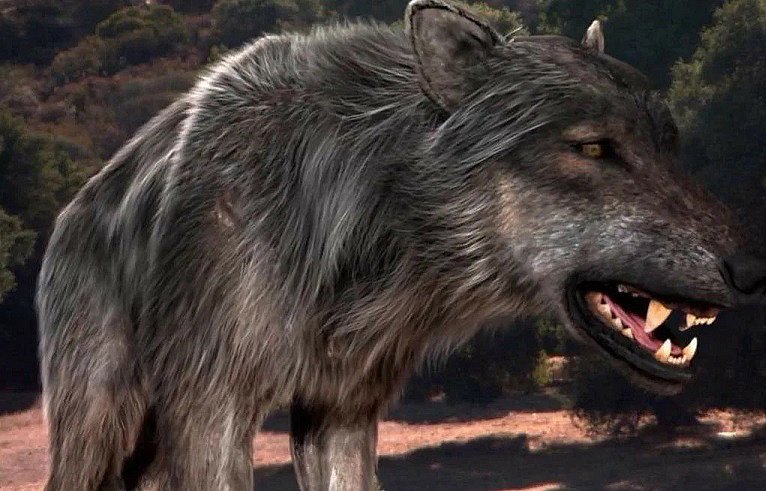
Recent research has allowed scientists to discover evidence of the presence of ancient wolves in the Americas during the Pleistocene. One of the specimens, found in Medicine Hat in Canada, has not been fully studied, but examination of its dentition indicates that it is the bone of a so-called “direwolf.”
The specimen dates back between 25,000 and 50,000 years and consists of just one jawbone, including several teeth. Previously, this specimen was classified as C.dirus, but new research has allowed scientists to identify it as a dire wolf.
As noted, the saber-toothed cat (Smilodon fatalis) was also found in this region, which confirms the theory that the ranges of this species and the dire wolf overlap. The latter turned out to have a wider range than previously thought, and it even migrated through the ice-free corridor connecting North America with Asia.
Comparative analysis of a putative dire wolf jaw bone, known as ROMVP 71618, with bones from other members of the species and gray wolves led scientists to conclude that the dire wolf was significantly larger than the gray wolf. This suggests that the sample taken for research belonged to an older individual.
This jawbone specimen thus became the first confirmed record of a direwolf in Canada. It's worth noting that dire wolves have no close living relatives and are not closely related to modern gray wolves.
The researchers' article was published in the Journal of Quaternary Science.