

British paleontologists have described a new genus of Mesozoic teleosaurs - close relatives of crocodiles that terrorized the sea coasts during the Jurassic period. The predator, whose remains were dug up in Britain more than a century ago, appears to have specialized in turtles, but would have easily eaten most of its other contemporaries.
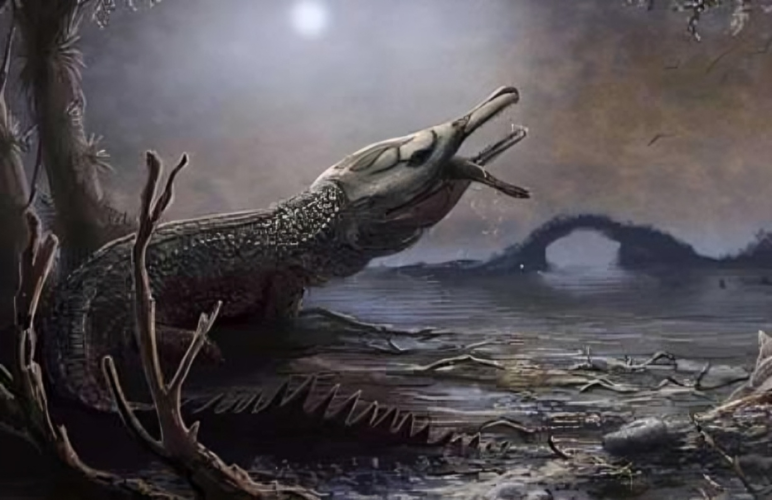
Lemmysuchus obtusidens
Reconstruction: Mark Witton
The new lizard was named Lemmysuchus obtusidens - in honor of the leader of the popular Motorhead rock band Lemmy (Ian Kilmister). “Lemmy would happily drink to Lemmysuchus, one of the nastiest sea creatures to ever inhabit the Earth,” explained the authors of the discovery.
The story of Lemmysuchus obtusidens dates back to 1909, when its fossilized remains were recovered from a clay quarry near Peterborough in Cambridgeshire. In the same layers belonging to the Callovian stage of the Jurassic period, the remains of another crocodile-like animal were found - Steneosaurus leedsi, which resembled modern gharials with its thin, elongated jaws, ideal for hunting mobile prey such as fish.
In contrast, Lemmysuchus obtusidens clearly preferred turtles or large prey with strong bones. With a total length of just under six meters, the powerful skull of Lemmysuchus reached a meter long, and the jaws were lined with large, blunt teeth, easily capable of splitting a turtle shell or crushing the limbs of a medium-sized dinosaur. So, according to the team of researchers, Lemmysuchus was one of the macrophage superpredators of its time, settling at the very top of the food pyramid.
For a long time, the remains of Lemmysuchus obtusidens were spent in the bowels of the London Natural History Museum under the name 'Steneosaurus' obtusidens - the specialists who were the first to study these specimens mistakenly attributed them to another genus. This misunderstanding became clear only during the next audit, when paleontologists at the University of Edinburgh became interested in the old bones. They eventually proved that at least five unique characteristics make it possible to distinguish the putative stenosaurus into a separate genus.
“I've always been into hard rock and Motörhead are one of my favorite bands, and since Lemmy died, I really wanted to name something after him,” said museum curator Lorna Steele. “At first I found a little crocodile from Morocco for this, but then he showed up and I thought, Oh my God!” This is the nastiest, rudest, largest saltwater crocodile. And he's perfect for my plans."
Saltwater crocodiles have been extinct for a long time, but in the Middle Jurassic, about 164 million years ago, they were a large, dominant group distributed throughout much of the planet, Steele said. Teleosaurs were much larger in size than modern crocodiles, and their back and belly were covered with a bony shell.
Article published in Zoological Journal of the Linnean Society
Lemmysuchus obtusidens
Reconstruction: Mark Witton
The new lizard was named Lemmysuchus obtusidens - in honor of the leader of the popular Motorhead rock band Lemmy (Ian Kilmister). “Lemmy would happily drink to Lemmysuchus, one of the nastiest sea creatures to ever inhabit the Earth,” explained the authors of the discovery.
The story of Lemmysuchus obtusidens dates back to 1909, when its fossilized remains were recovered from a clay quarry near Peterborough in Cambridgeshire. In the same layers belonging to the Callovian stage of the Jurassic period, the remains of another crocodile-like animal were found - Steneosaurus leedsi, which resembled modern gharials with its thin, elongated jaws, ideal for hunting mobile prey such as fish.
In contrast, Lemmysuchus obtusidens clearly preferred turtles or large prey with strong bones. With a total length of just under six meters, the powerful skull of Lemmysuchus reached a meter long, and the jaws were lined with large, blunt teeth, easily capable of splitting a turtle shell or crushing the limbs of a medium-sized dinosaur. So, according to the team of researchers, Lemmysuchus was one of the macrophage superpredators of its time, settling at the very top of the food pyramid.
For a long time, the remains of Lemmysuchus obtusidens were spent in the bowels of the London Natural History Museum under the name 'Steneosaurus' obtusidens - the specialists who were the first to study these specimens mistakenly attributed them to another genus. This misunderstanding became clear only during the next audit, when paleontologists at the University of Edinburgh became interested in the old bones. They eventually proved that at least five unique characteristics make it possible to distinguish the putative stenosaurus into a separate genus.
“I've always been into hard rock and Motörhead are one of my favorite bands, and since Lemmy died, I really wanted to name something after him,” said museum curator Lorna Steele. “At first I found a little crocodile from Morocco for this, but then he showed up and I thought, Oh my God!” This is the nastiest, rudest, largest saltwater crocodile. And he's perfect for my plans."
Saltwater crocodiles have been extinct for a long time, but in the Middle Jurassic, about 164 million years ago, they were a large, dominant group distributed throughout much of the planet, Steele said. Teleosaurs were much larger in size than modern crocodiles, and their back and belly were covered with a bony shell.
Article published in Zoological Journal of the Linnean Society