

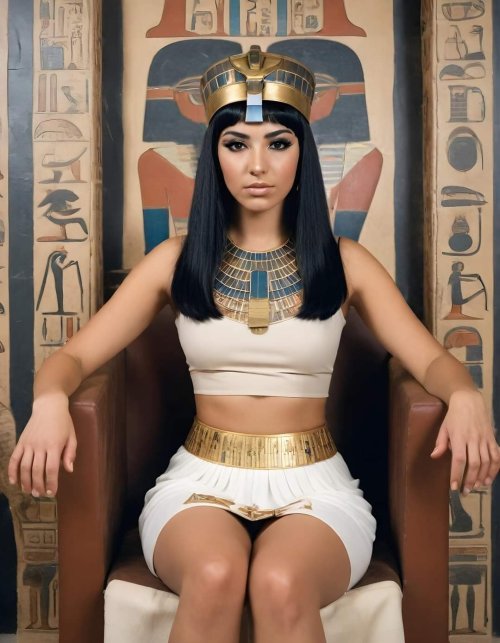
DID YOU KNOW THAT EGYPTIAN QUEENS INSINUATED THAT WOMEN SHOULD RULE THE WORLD?.

 - Shocking Testimony
In the vast desert of ancient Egypt, Egyptian queens carved a legacy that defied the gender norms of her time, suggesting that women not only could, but should, run the world.
Hatshepsut, one of the few female pharaohs, ruled masterfully for nearly two decades in the 15th century BC. Her reign was a period of prosperity and peace, marked by magnificent construction works and successful trade expeditions. What stood out about Hatshepsut was her audacity to portray herself as a male pharaoh, thereby defying established norms and reinforcing the idea that a woman could exercise supreme leadership effectively.
On the other end of Egyptian history, we find Cleopatra VII, a legendary figure who fought to preserve Egypt’s independence in a world dominated by Rome. Her political savvy and her relationships with powerful leaders like Julius Caesar and Marco Anthony are legendary, proving that a woman could handle the threads of power with skill and determination.
While these queens did not explicitly express their belief that women should rule the world, their reigns speak for themselves. In a world dominated by men, they proved that effective leadership has no gender, and that capacity, intelligence, and strength of character are the true qualities that matter.
In today's era, where the fight for gender equality and women's empowerment remains relevant, the stories of these Egyptian queens take on a new meaning. They remind us that female leadership is not only possible, but it can also be remarkably effective. Perhaps, then, what these Queens hinted was a prophetic vision for the future: a world where gender does not determine leadership, but ability and suitability.