

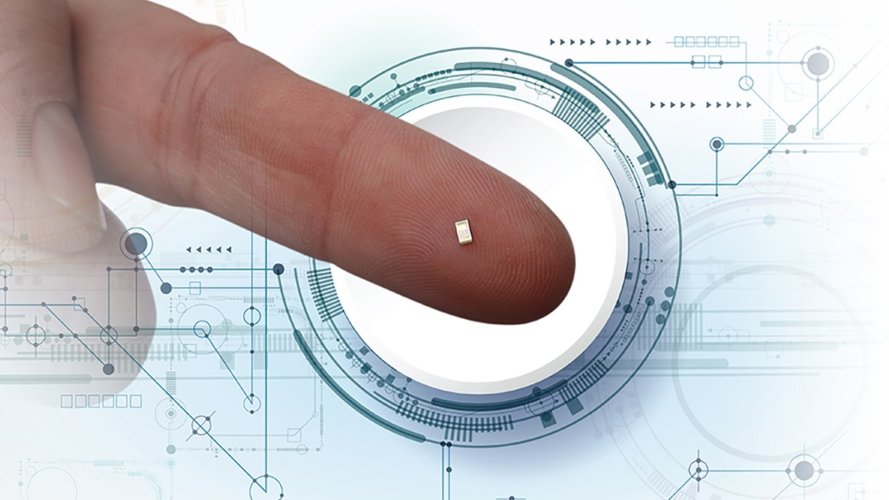
A touch panel, similar to a smartphone screen, can now be made of ceramics, plastic and even wood, and it will not be subject to any contamination. The world's smallest ultrasonic sensor on a chip, developed by UltraSense Systems, will help with this.
There are a number of approaches to creating a touchpad, but each has its drawbacks. Most methods only work with a limited class of materials. Many technologies are vulnerable to dirt, liquids or oily substances coming into contact with sensitive surfaces. Some devices cannot be operated with gloves, while others cannot distinguish between strong pressure and weak pressure.
The approach used by UltraSense Systems engineers is devoid of all of the listed disadvantages. It is based on ultrasonic scanning of the panel material. Ultrasonic waves record even the microscopic deformation of a substance and make it possible to measure the force of pressing.
According to the company's press release, this technology allows the use of touch surfaces made of metal, glass, wood, ceramics and plastic. The operation of the device is resistant to contamination and allows the use of gloves. In addition, it consumes very little electricity.
At the same time, the sensor itself, together with the microprocessor, has dimensions of 1.4 x 2.4 x 0.49 millimeters. In this regard, manufacturers call it the smallest in the world. All interaction with the ultrasonic sensor is carried out by its own chip, so the new component can be built into a device with almost any processor.
Manufacturers see a range of possible uses for their brainchild.
For example, touch buttons can be placed on the sides and back of the smartphone. This will help, for example, to comfortably take selfies with one hand.
Control elements can be built into any household appliances and even furniture. After this, to turn on or off the light in the room, it will be enough to touch the table top in the right place (and with such a miracle of technology, how can you not die from the consequences of physical inactivity?).
The innovation will also be useful for creating new medical devices, virtual and augmented reality devices, and even for more convenient driving.
The developers note that the new product will be presented to interested parties before the end of 2019, and as early as next year it could become part of new smartphones.