

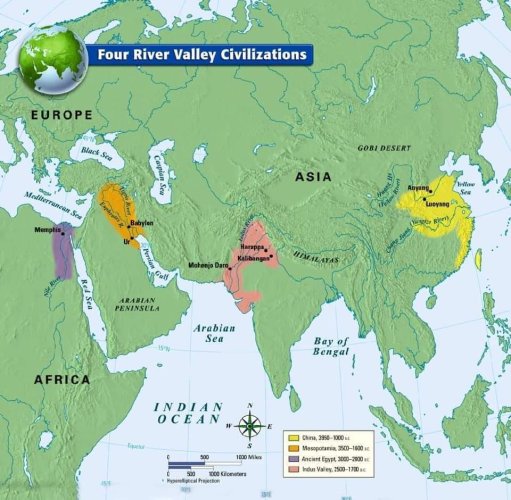
The Cradle of Civilization: Rivers and the Dawn of Humanity
Water is the lifeblood of civilization. It's no coincidence that the earliest civilizations arose near rivers like the Tigris, Indus, and Nile. These rivers provided not just sustenance but also fertile land for agriculture, fostering the development of permanent settlements.
From Hunter-Gatherers to Farmers: A Shift Towards Complexity
These #riparian communities thrived. Abundant food led to increased leisure time, fostering curiosity and innovation. People transitioned from a hunter-gatherer lifestyle to settled farming, allowing for the development of social hierarchies beyond just food producers.
The Role of Belief Systems in Early Societies
Early humans, lacking scientific explanations for natural phenomena, attributed them to unseen forces. This led to the rise of complex belief systems, with deities and rituals serving as explanations for the world and a source of comfort during uncertain times.
Birth of River Valley Civilizations: Mesopotamia, Egypt, Indus Valley, and China
Around 8,000 to 13,000 years ago, the first complex societies emerged in Mesopotamia, Egypt, the Indus Valley, and China. These #civilizations relied on subsistence farming, where food production primarily supported the population itself. However, unlike hunter-gatherers, they were able to generate surpluses that allowed for the development of specialized roles beyond agriculture.
Mesopotamia: The Fertile Crescent and the Cradle of Innovation
Considered the earliest civilization, Mesopotamia flourished between the Tigris and Euphrates rivers. The fertile land and reliable water source allowed for the development of agriculture and animal domestication around 10,000 BC. This region is credited with numerous innovations like written communication (cuneiform tablets), art, and trade.
The Indus Valley Civilization: A Flourishing Urban Culture
The Indus Valley civilization, also known as the Harappan civilization, thrived in present-day Afghanistan, Pakistan, and India around 5,300 years ago. This urban civilization, distinguished by its advanced city planning, flourished along the Indus River basin. The Indus Valley people were skilled mathematicians, potters, and craftspeople, leaving behind evidence of a rich artistic tradition.
Ancient Egypt: Pyramids, Mummies, and a Legacy in Stone
Flourishing along the Nile River from 3100 BC to 2686 BC, Ancient Egypt is one of the most recognizable civilizations. The majestic pyramids stand as testaments to their engineering prowess and serve as a reminder of their powerful empire. Beyond these wonders, Egyptians developed the practice of mummification, solar calendars, and advancements in art and architecture that continue to influence the world today.
The Rise of Chinese Civilization: From Millet to Rice Farming
China's early agricultural civilization emerged during the Xia dynasty along the Yellow River around 4000 BCE. Initially cultivating millet, these early farmers later shifted to rice production in the more fertile Huai River valley.
From Neolithic Tools to Complex Societies: A Glimpse into Early China
Prior to the rise of complex civilizations, China experienced a Neolithic period (after 5000 BCE) characterized by the use of stone tools, domesticated animals, and hunting. This period also saw the emergence of exceptional pottery and bone implements, suggesting artistic expression and potential inter-tribal conflict. Notably, some evidence suggests a period of female dominance during this time, which transitioned to a patriarchal structure as societies grew more complex.
Conclusion
The rise of civilization was a pivotal moment in human history. The availability of water and the shift towards agriculture laid the foundation for complex societies with specialized roles, social structures, and cultural advancements. The ingenuity and adaptability of these early civilizations continue to inspire and inform us today.
Iqbal Latif