

Scientist Polyakov: space debris can destroy civilization
The remains of space satellites will block the Earth's magnetic field, and we will find ourselves under the “shower” of hard cosmic radiation, says a new study. In fact, everything is even worse, Vladimir Polyakov, candidate of technical sciences and ionosphere specialist, told Komsomolskaya Pravda. The metal dust into which spent satellites turn can give rise to superlightning, ball lightning, electrical explosions - and all this will ultimately destroy civilization.
WHAT WE'RE TALKING ABOUT
The study by Sierra Salter-Hunt from the University of Iceland appeared in December, but did not attract attention then (and has not yet been peer-reviewed). But now the Western media are writing about him vying with each other. Experts admit that although not all conclusions are solidly substantiated, the scientist seems to have hit upon a whole bunch of problems - including why the climate is changing.
Humanity launches more than a thousand satellites a year (the record was in 2022, 2474 satellites). Most of them do not live long: now there are only 7 thousand active satellites in orbit, the rest have already “died”.
“The rest” is, according to NASA, about 25 thousand objects. The satellite moves as a whole for some time, then begins to disintegrate. According to NASA, there are now half a million objects in orbit ranging in size from 1 to 10 cm, and, please note, 100 million from 1 mm. That is, it is essentially dust. Satellites sooner or later turn into metal dust. The study is about her.
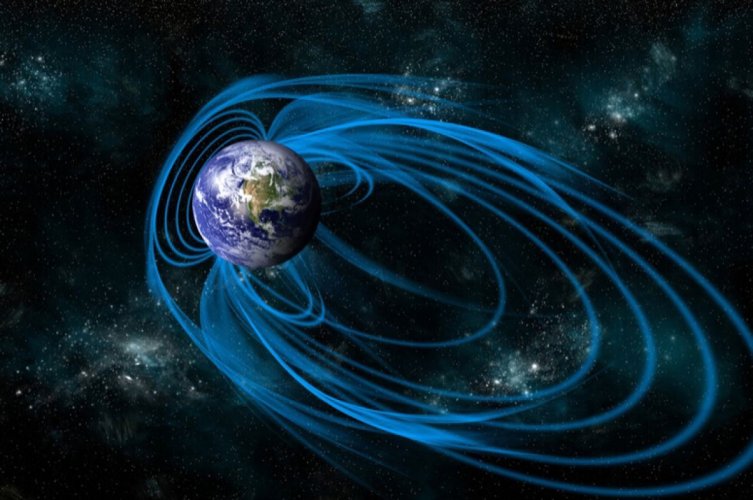
The researcher believes that metal dust will begin to block the lines of force of the Earth's magnetic field. Normally, the field lines are pressed to the Earth on the day side (the solar wind presses on them) and “spread out” over hundreds of thousands of kilometers on the night side. This is how nature arranged it. Metal dust will “squeeze” the power lines and prevent them from going above 100-300 km, the scientist believes. This will lead to a weakening of the magnetic field and something... we don't know yet. The dust will remain in orbit forever and will not go down. So the new reality is forever.
Without a magnetic field, life on Earth is impossible. It is this that captures hard cosmic radiation, twists and turns it on the lines of force and, weakened, dumps it in the region above the magnetic poles, where the radiation safely “burns up” at high altitudes (auroras). At a minimum, the upper atmosphere will be scorched, and then away we go, scares Salter-Hunt.
The researcher was criticized for exaggerating the amount of metal debris (and who knows how much there is), but in general they agreed with the conclusions.
MUDDY PLANS
Russian physicist and radio engineer Vladimir Polyakov is a specialist in the study of the ionosphere. The ionosphere is a conductive (ionized) layer created by nature high above the Earth. The role of the ionosphere is colossal: according to some hypotheses, it is it that determines global weather.
Metal dust can essentially create an “artificial ionosphere,” Polyakov fears. We live in a natural electric field. It’s like inside a capacitor: one “plate” is the Earth, the other is the ionosphere. The layer of metal particles creates another “lining” that will confuse everything.
Western researchers are constantly trying to spray metal dust into the atmosphere, recalls Polyakov. They explain to the people: this is necessary to combat “global warming.” Dust, they say, blocks sunlight. In fact, Polyakov suggests, the military may be behind such plans. Dust is an excellent mirror for over-the-horizon radars. Such radars best “penetrate” enemy territory with their signal. But the natural ionosphere, from which signals are reflected, is capricious. Why not create an artificial one? And bring in “global warming.”
Perhaps some experiments are already underway. There is an active discussion on the Internet: why did strange, gray tracks begin to appear behind airplanes? Ordinary marks quickly dissipate, but these ones hang on for a long time. And there is an (unconfirmed) hypothesis: NATO planes throw out metal filings so that an over-the-horizon radar signal can penetrate along this “path.”
And here, it turns out, there is no need to be clever. Man, having polluted space, has already created a reflective layer. Is this why the Icelandic researcher's groundbreaking work has yet to pass peer review? Didn't she divulge that?
WHAT WILL HAPPEN. And yet, what are the consequences?
They can be unpredictable, says Polyakov. So far, nature has arranged it this way: the ionosphere receives a charge from space, and the charge gradually “flows” down with the help of lightning. The artificial layer will accumulate charge even more actively. And what will it look like? Lightning striking from a clear sky? Went for a walk and found yourself under electrical “fire”? Is there nowhere to hide? And lightning – not ordinary, but hard, powerful? All this cannot be ruled out, says Polyakov.
Don't forget about ball lightning. Their nature is still unclear. To the observer they appear as plasma (?) balls with strange, unpredictable behavior. If ball lightning explodes, the technology nearby is finished, and so is the person along with it. Of course, one way or another it is an electrical phenomenon. What now, will they become permanent guests of our homes?
Scientists have already thought about an “electric” Armageddon scenario. A breakdown from the ionosphere to Earth, a series of powerful discharges, and goodbye computers, goodbye Internet. Is the end of civilization closer than we think? Still, this is only a hypothesis for now, says Vladimir Polyakov.
And since it’s a hypothesis, let’s continue to fantasize. Climate and weather. It has been practically proven that the incredible drought in the summer of 2010 was caused by disturbances in the ionosphere. Electric fields prevent the creation of “seeds” of rain, and atmospheric circulation is disrupted. Is it not the old satellites that are the cause of the notorious “global warming”?
But the study seems to be forcing a new look at what humans do to nature (and to themselves).