

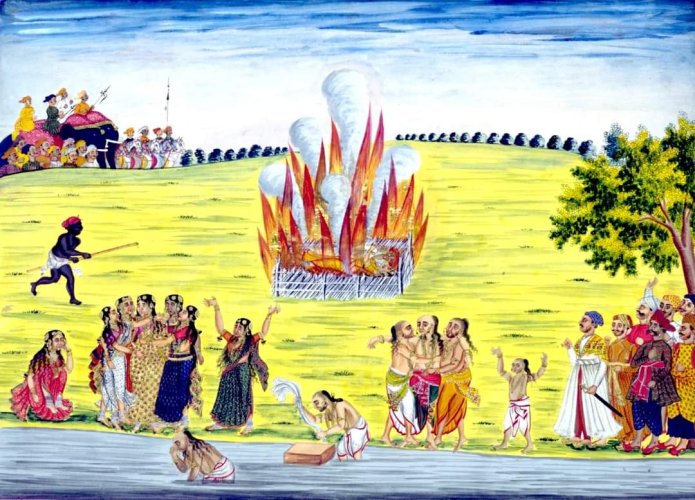
MUGHAL RULERS TRIED TO STOP SATI PRACTISE as PER EUROPEAN TRAVELLERS
Although the Mughals interfered little with Hindu customs, there was one ancient practice which they sought to stop. This was sati, or the custom of widows, particularly those of the higher classes, burning themselves on their husbands' funeral pyres. Akbar had issued general orders prohibiting sati, and in one noteworthy case, personally intervened to save a Rajput princess from immolating herself on the bier of her husband. Similar efforts continued to be made in the succeeding reigns. According to the European traveller Pelsaert, governors did their best to dissuade widows from immolating themselves, but by Jahangir's orders were not allowed to withhold their sanction if the woman persisted.1
Tavernier, writing in the reign of Shah Jahan, observed that widows with children were not allowed in any circumstances to burn, and that in other cases governors did not readily give permission, but could be bribed to do so.2
Aurangzeb was most forthright in his efforts to stop sati. According to Manucci, on his return from Kashmir in December 1663, he "issued an order that in all lands under Mughal control, never again should the officials allow a woman to be burnt." Manucci adds that "This order endures to this day."3 This order, though not mentioned in the formal histories, is recorded in the official guidebooks of the reign.4
Although the possibility of an evasion of government orders through payment of bribes existed, later European travellers record that sati was not much practiced by the end of Aurangzeb's reign. As Ovington says in his Voyage to Surat: "Since the Mahometans became Masters of the Indies, this execrable custom is much abated, and almost laid aside, by the orders which nabobs receive for suppressing and extinguishing it in all their provinces. And now it is very rare, except it be some Rajah's wives, that the Indian women burn at all."5
References:
1. Francisco Pelsaert, Jahangir's India, trans. by W. H. Moreland and Peter Geyl (Cambridge, 1925), p. 79.
2. Jean Tavernier, Travels in India, trans. by Valentine Ball (London, 1925), II, 163–64.
3. Nicolo Manucci, Storia do Mogor, trans. by William Irvine (London, 1906–1908), II,, 97.
4. Jadunath Sarkar, History of Aurangzib (Calcutta, 1916), III, 92.
5. John Ovington, A Voyage to Surat (London, 1929), p. 201.
Photo: Sati Ceremony, painted c. 1800 at Victoria & Albert Museum, London