

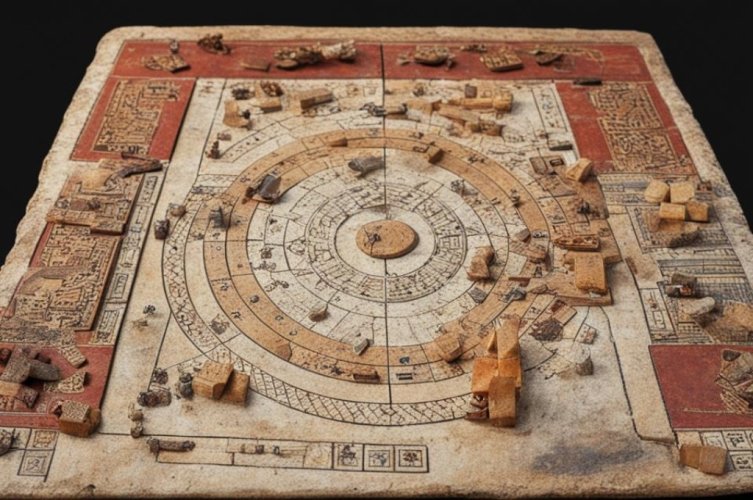
In Turkey, at the 5,000-year-old Basur Höyük mound, archaeologists discovered a collection of 49 stone figurines: pigs, dogs, pyramids and columns, skillfully carved and painted. These tiny artifacts have raised many questions among researchers. Three years after the discovery, scientists are still trying to figure out how to play with them.
However, despite extensive searches, the board itself for this mysterious game was never found. The discovery was reminiscent of other ancient board games, such as Senet in Ancient Egypt, where excavations revealed not only the rules of the game, but also the religious beliefs of the time. The Egyptians played Senet 5,500 years ago. Excavations of various tombs, including those of Tutankhamun, have allowed researchers to reconstruct the rules of this ancient game.
Playing with 30 Senet squares became not only entertainment, but also an immersion into the world of the spiritual. Researcher Peter Piccione suggests that the game was used for ritual purposes, allowing the ancient Egyptians to influence the destiny of their soul. Each square on the board represented stages of the afterlife, emphasizing the game's connection to religion and ritual.
The Royal Game of Ur, popular in Mesopotamia 4,500 years ago, came to attention thanks to Irving Finkel, an expert in the ancient Mesopotamian cuneiform language. A researcher from the British Museum in London deciphered the incomprehensible combination of writing and diagram in 1979, becoming the owner of “the oldest set of game rules.”
These ancient board games turned out to be not only entertainment, but also a mirror of the society of their time. Researcher Walter Crist of Arizona State University found that over time, the places where board games were played changed, reflecting sociocultural changes from elite societies to states with social hierarchies.