

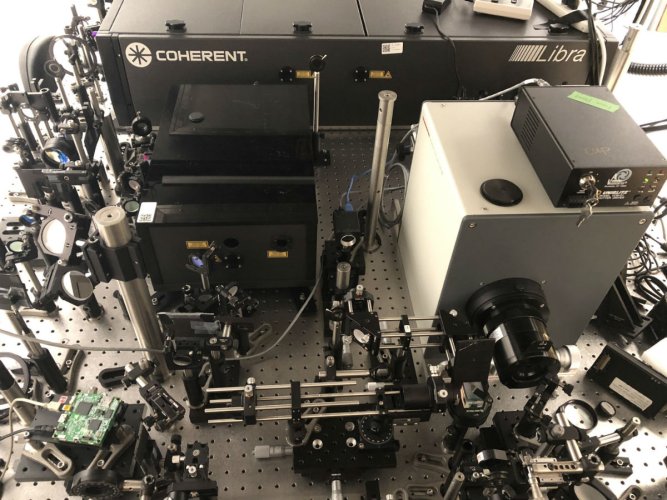
Scientists have created a camera that creates ten trillion frames per second. According to the study's press release, this is a world record. The new development will help record processes that no one has ever seen.
The achievement is described in a scientific paper published in the journal Light: Science & Applications by a team led by Jinyang Liang of the National Research Institute of Canada.
Scientists perfectly understand the meaning of the saying “time waits for no one.” Processes in fast electronics occur in billionths of a second. Molecules vibrate with a period of trillionths of it. The interaction of light with matter occurs another thousand times faster, and the movement of electrons in an atom is a million times faster.
How to study such fast processes? For this, physicists are creating femtosecond and even attosecond lasers. The laser pulse acts on the sample with the desired characteristic time. But the result of the impact also needs to be recorded somehow. Although modern technologies provide some possibilities in this regard, we are not talking about a full-fledged image.
Existing cameras are too slow to capture such processes in real time. They require repeating the same action over and over again. This can be compared to the swinging of a pendulum: the camera is unable to capture a single movement, but each swing is as similar to the previous one as two peas in a pod. In the end, the total exposure time is sufficient to get a high-quality shot.
But what to do if the process being studied is not like the swing of a pendulum, but like hitting glass with a hammer? The sample is destroyed by the first impact, and it can no longer be repeated many times. Such things need to be recorded in real time, there is simply no other way.
The authors solved this problem. As a starting point, they took the technology of compressed ultra-fast photography, which makes it possible to take one hundred billion frames per second (the authors of Vesti.Nauka (nauka.vesti.ru) previously talked about it). Having speeded up the shooting process a hundred times, the researchers naturally experienced image deterioration.
Then the scientists added a “partner” to their brainchild. This is the second camera, which does not shoot as fast as the first, but gets a better quality frame. It is used as an additional source of information. With this help, the researchers decipher the "hurry" data, turning them into a fairly detailed picture using the Radon transform.
The resulting system may have set a world record for the fastest real-time shooting. However, Vesti.Nauka wrote about a camera created by Russian scientists that takes a frame every 50 femtoseconds. This does not necessarily mean that Liang's technology is in vain in its claim to primacy. “Camera” can be called devices of different designs, which are not necessarily cameras in the usual sense of the word.
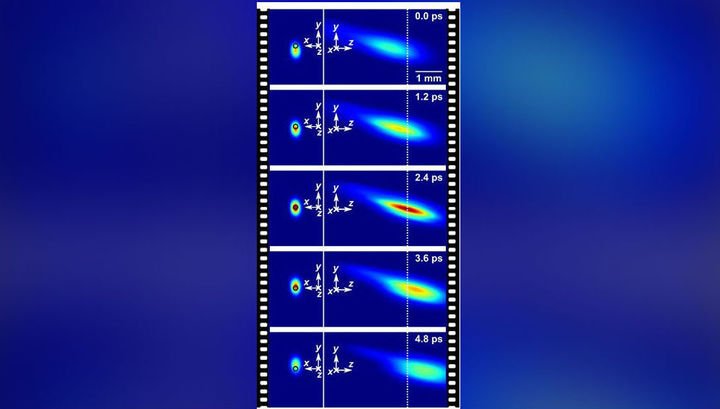
Canadian researchers demonstrated the capabilities of their brainchild by recording the process of focusing a single femtosecond laser pulse. This action was captured in 25 frames, filmed at intervals of 400 femtoseconds. “On film” you can see how the shape, intensity and angle of the light pulse changes.
"This is an achievement in itself, but we are already seeing opportunities to increase the speed to one quadrillion (a thousand times a trillion - editor's note) frames per second!" - says Liang.